
The Perks of Literature by Kyra Chang
Six books, one graphic novel, and one drama.
That’s what the IB Lit HL seniors analyzed over the last two school years, all in preparation for the oral exam they would take in the second semester of their senior year. The individual oral presentation, or the IOP, was an exam where the students verbally discussed a global issue and the literary value of two works they had studied. Ms. Amy Kaminski was the first year English teacher while Mrs. Courtney Boos was the second year teacher, and both had the responsibility of choosing what literature the students would learn. “Ms. Kaminski and I actually have a lot of rules to follow within IB’s parameters. They like to see a wide variety of texts, so we try to select pieces that showcase different gendered authors, different time periods/eras of literature, different forms of literature, all that reflect diverse worldly settings and origins. We also try to consider pieces that relate to one another to help make assignments like the IOP a little bit easier,” said Mrs. Boos.
Each student had to pick one translated work and one work that was originally in English. Senior Joy Weng was 1 of 73 IB Lit seniors that had to make the tough decision between which works she wanted to use. As her translated work she chose the graphic novel Persepolis by Marjane Satrapi and she chose 1984 by George Orwell as her other work. “They were the most recent books so they were fresh in my mind,” said Weng. For one week, Weng worked tirelessly at her desk as she filled out her IOP proposal sheet, telling Mrs. Boos what global issue she was going to discuss and what authorial choices she would be analyzing in her presentation. Weng found the hardest part of planning was finding good authorial choices. “It was hard finding ones that related to my global issue,” said Weng. Her global issue had to do with manipulation of information by governments, so she had to search through her work for good examples of this issue as seen through literature.
In total, the students had two and half weeks to prepare for this exam before the official testing days started, going from January 28th to February 8th. Mrs. Boos did her best to make this process as easy as possible for the students. “I try to scaffold the steps and help guide the students the best I can. We also listen to examples from past years,” said Boos. The last major thing the students needed to do was create their ten-bullet point outline that they’d be able to reference during the exam. “Everything was good, but I struggled on finding authorial choices that related to my global issue,” said Weng.
While the IOP process may have seemed tedious, both Weng and Mrs. Boos believed that it had many benefits in the future. “The real-world application and benefits are never ending in my opinion. No matter what profession students want to go into, speaking skills are required,” said Mrs. Boos. “Further still, for many jobs, formal speaking, like giving a presentation to a boss or presenting findings to a patient, are required. In addition, I have heard of many students' seeking higher education like a Master's degree or entrance to a specific program, having to sit for formal interviews. The IOP helps prepare students for all of this.” Weng had similar feelings about the exam. “It’ll help me better communicate my ideas. I often struggle with putting my thoughts into words, so the IOP will help me better my skills,” said Weng.
Caption:
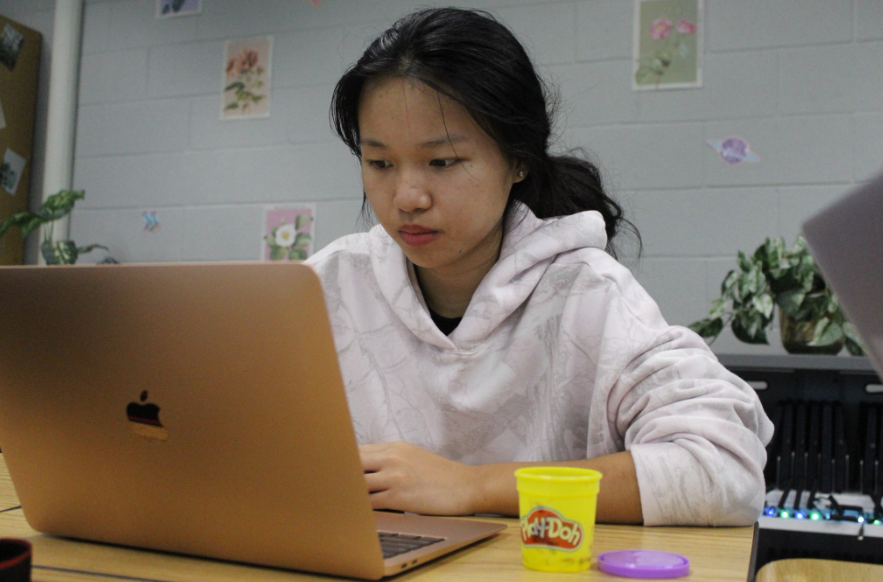
Hands-On Thinking: During Mrs. Courtney Boos’ 6th period IB Lit class, senior Joy Weng plays with PlayDoh as she plans what to write in her IOP proposal. A white basket lay on a table close to the door in the classroom, full of different tubes of playdoh. Weng often grabbed one while doing her work, easing into the classroom’s calm environment. “PlayDoh helps me relax and de-stress during class,” said Weng.
Photo by Kyra Chang