
Planets in Perspective by Lily Majors
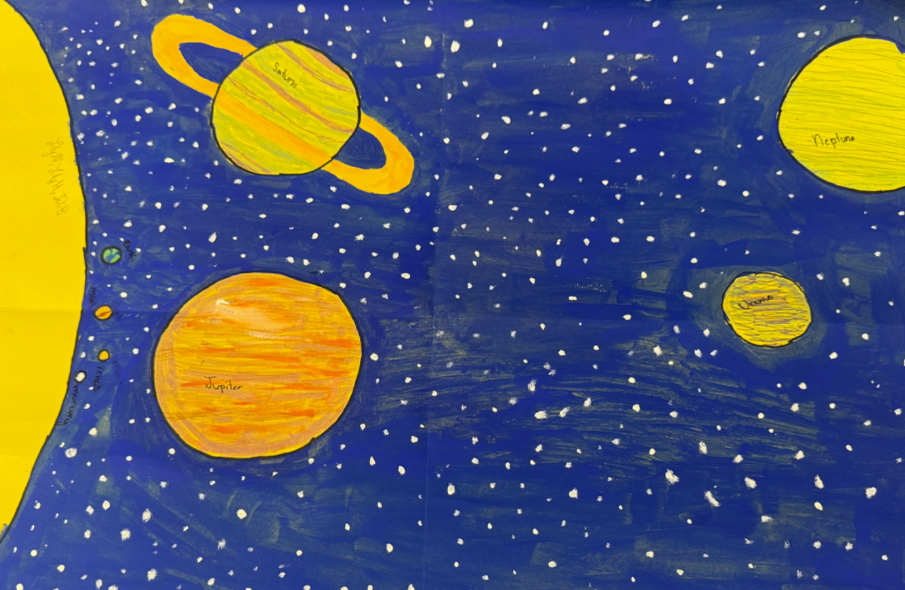
Students in physics classes recently completed a hands-on solar system poster project designed to help visualize the scale of the planets. The assignment required students to convert real planetary distances into centimeters and accurately place each planet on a poster. Many students worked collaboratively, spending several days in and out of class measuring, painting, and calculating. The project emphasized both accuracy and creativity, allowing students to better understand how the planets are positioned in relation to the sun.
Sophomore Joli Bartczack, who completed the project during first-period physics, said the work was manageable but detailed. “Perfectly measuring how far the planets were apart and their diameter was tedious,” Bartczack said. She explained that her group worked for about four days and took pride in the artistic aspect of the assignment, especially the painted planets. “I did Jupiter and I think it’s really pretty,” Bartczack said. She also noted that the extreme distances surprised her, explaining that “Pluto was supposed to be 35 centimeters from the sun, but that wouldn’t have fit on the page,” so her group placed it along the edge of the poster.
Physics teacher Laura Zamora said the project was meant to go beyond memorization and help students grasp the true scale of the solar system. “It’s tough to create a scale model of the solar system that accounts for both size and distance,” Zamora said. She added that the project highlighted the differences between inner and outer planets and encouraged students to reflect their personalities in their work. Zamora said hands-on projects like this are more effective than traditional notes because “creativity is a great teacher,” adding that posters and other visual activities help students discover and understand concepts on their own.
Caption:
Visualizing the Planets: Students work on a scaled solar system poster during physics class to visualize planetary distances and sizes. The project was assigned to help students better understand how far apart the planets are and how difficult it is to accurately represent both size and distance on one model. Students converted real distances from miles into centimeters and illustrated each planet while adding creative details to reflect their personalities. “Perfectly measuring how far the planets were apart and their diameter was tedious,” said sophomore Joli Bartczack, noting that Pluto’s distance had to be adjusted to fit on the page. Physics teacher Laura Zamora said the assignment was designed to deepen understanding through hands-on learning, explaining that “creativity is a great teacher,” especially when students can visualize concepts for themselves. Photo by Lily Majors