
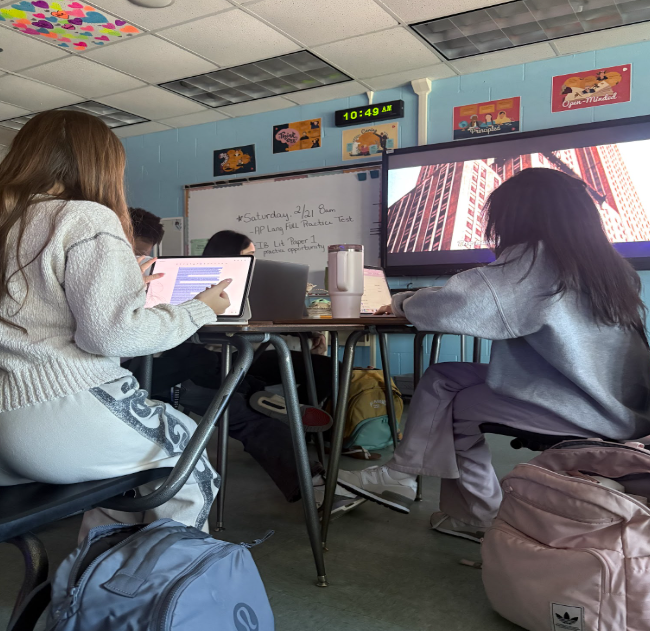
Belen Castillo and Lucie Frank Discuss about practice AP Lang Exam by Chloe Strong
Students in AP Language and Composition spent three hours simulating the pressure of the real exam during a full-length practice test earlier this semester. The timed assessment mirrored the format of the official AP exam, giving juniors an opportunity to experience the pacing and expectations firsthand. Both Belen Castillo and Lucie Frank said the experience challenged them while also building their confidence. Through multiple-choice questions and three essays, students tested their analytical and writing skills in a setting designed to feel authentic.
Belen Castillo, a junior, said she entered the course at the start of the school year and approached the practice exam as a serious benchmark. Her teacher organized the test to give us extra practice before we take the actual AP exam, and to help students get a feel for the timing and format of the real test. Castillo said the exam, which lasted about three hours, closely reflected the structure of the official test with a synthesis essay, rhetorical analysis, and argument essay. Although she believed she performed fairly well, she admitted the rhetorical analysis posed the greatest challenge. “It’s a lot to get done in a short amount of time!” Castillo said, explaining that analyzing how an author uses rhetoric required both focus and efficiency. Despite the difficulty, she said the experience helped her recognize areas for improvement and left her feeling “more confident and prepared for the real AP exam.”
Lucie Frank also described the practice test as a valuable preparation tool. Frank, a junior, said she began the AP Language and Composition course at the beginning of the year and appreciated the opportunity to rehearse under realistic conditions. “It’s meant to help us get used to the timing and format of the real exam,” Frank said. Like Castillo, she completed a multiple-choice section and three essays during the three-hour session. Frank said she “did pretty well” overall but found the rhetorical analysis essay to be the hardest component. “Analyzing a text and explaining the author’s use of rhetoric under time pressure isn’t easy,” Frank said. She explained that the timed setting pushed her to think critically and write efficiently.
Both students agreed that the simulation strengthened their readiness for the official AP exam. Castillo said the practice helped her understand the pacing of each section, while Frank noted it gave her “a better understanding of the exam’s pace and the types of questions.” By completing the full-length assessment, each student gained insight into personal strengths and weaknesses before test day. As the AP exam approached, Castillo and Frank said they felt more prepared to meet the demands of the challenge ahead.
Caption:
Preparing For The AP Exam: Belen Castillo and Lucie Frank study for the AP Language and Composition exam during class as they review essays and practice prompts. Castillo and Frank, both juniors, prepared for the full-length practice test earlier this semester to strengthen their understanding of pacing and question types. Before taking the three-hour simulation, they reviewed rhetorical strategies and practiced timed writing to improve their analysis skills. “It’s a lot to get done in a short amount of time,” Castillo said. Frank said the preparation helped her feel more confident, adding, “It’s meant to help us get used to the timing and format of the real exam.”