
Blood Moon Lights Up the Night Sky by Brooke Johnson and Ereny Elrayis
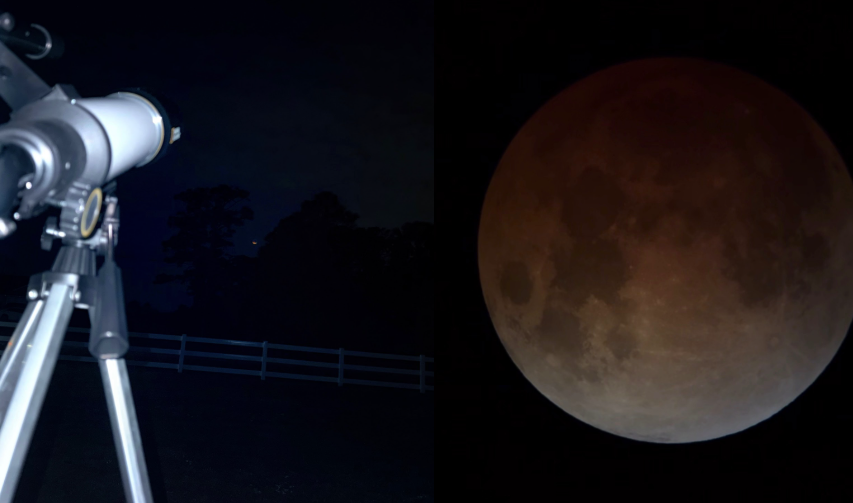
On March 3rd, a blood moon lunar eclipse was visible in the night sky. Many people looked up to see the moon turn a reddish color for a short period of time. The event also connected to what students in the astronomy class had been learning about space and how different celestial events happen.
A lunar eclipse happened when the moon traveled into the shadow of the Earth. When this occurred, sunlight was blocked by the Earth, which caused the moon to darken and sometimes turn a reddish color. This color change was temporary and only lasted during the eclipse. Lunar eclipses do not happen very often, which made the March 3rd event interesting for people who enjoy watching the night sky.
Astronomy teacher Gregory Stauffer explained why learning about space can be important. “I believe that learning astronomy is useful because it allows us to realize that earth is really small and how much we should take care of it,” Stauffer said. He also shared what he enjoys most about teaching the class. “The thing that I like most about teaching astronomy is actually the students that take it,” Stauffer said.
Students in the astronomy class said they enjoyed learning about topics like eclipses and other things about space. Gianna Wilson, a ninth grader, shared why she liked the class. “I like taking astronomy because I like learning about how space works,” Wilson said. She also said that some parts of the class are especially interesting to students. “I think the projects are the most fun part about taking astronomy,” Wilson said.
The class often studies events like eclipses, planets, and other objects in space. Lessons can include learning how the solar system works and how different space events happen. Projects and activities help students understand these ideas in a more hands-on way.
Events like the March 3rd lunar eclipse gave students a real-life example of the kinds of things they learned about in astronomy. Seeing the moon change color during the eclipse helped show how space events can happen right above us, and it gave students a chance to connect what they learn in class to something they could actually see in the sky. The moon slowly turned a reddish color as the Earth moved between the sun and the moon. This event caused the moon to appear darker and sometimes even a little bigger in the night sky.
A lunar eclipse happens when the sun, Earth, and moon line up, and the Earth’s shadow covers the moon. During a blood moon, the moon can look red or orange because sunlight passes through Earth’s atmosphere before reaching the moon.
Students in the school’s astronomy course were especially excited to see the event. The class studies space, planets, and other objects in the universe, so the eclipse was a perfect example of something they learn about.
Isaiah Lorentz, an 11th grader in the class, shared why he enjoys studying astronomy. “To an extent it’s not the big first option, but it’s cool and you get to learn a lot with the teaching,” Lorentz said. He also explained that his interest started when he was younger. “I liked it when I was little, and learning about it is fun,” he added.
Another student, Sofia Rodriguez, a 12th grader, said her interest in space was connected to her family. “My step dad works at NASA,” Rodriguez said.
Events like the blood moon eclipse helped students see the concepts they learn in class happening in real life. The astronomy course continued to give students the chance to explore space and understand the science behind events that happen in the night sky.
Captions:
The moon transforms into a deep, reddish hue as Earth's shadow envelops it during a total lunar eclipse. This stunning celestial display, a recurring event in the night sky, occurs when the sun, Earth, and moon align perfectly. Isaiah Lorentz, an 11th grader, shared his enthusiasm, noting, "It was fun like it was when I was little and learning about it," a sentiment amplified by his stepfather's work at NASA. Sofia Rodriguez, a 12th grader, further explained the spectacle: "Sun, Earth, moon make the moon a different color and bigger sometimes; it's at night." This alignment offered a unique opportunity to witness the interplay of our solar system's bodies.
BLOOD MOON: A telescope pointed toward the night sky as the blood moon lunar eclipse on March 3 appears low over the trees. During a lunar eclipse, the moon moved into Earth’s shadow, which temporarily changed its color to a reddish shade. “Lunar eclipses change the moon’s color, and they happen 2–3 times a year. Christopher Columbus also used his knowledge of an upcoming lunar eclipse to scare some of the natives,” said astronomy teacher Greg Stauffer. Photo by: Brooke Johnson