
Artemis II Launch Inspires Many and Makes History by Ereny Elrayis and Brooke Johnson
In April 1 2026, NASA successfully launched the Artemis II rocket, marking a big step forward in space exploration. The launch was exciting for many people, especially those who worked on the project. It also connected back to earlier missions like Apollo, showing how far technology has come over time. Many people believed this mission was important for the future of humanity and space travel.
For the families of those involved, the day of the launch was full of emotions. Carrie Friday shared how her husband felt, saying, “He was very proud and anxious and nervous bc this time it had people for the first time, and he felt like their lives were on his hands.” Even though it was stressful, all the hard work paid off in the end. She explained, “The outcome of the rocket launch was successful and now they are planning to speed up the process of the next ones.” This showed how important his work was to the mission’s success.
The launch also inspired people and impacted future goals. Carrie Friday said, “It does affect his future career goals, but they never got to see rocket launches growing up so being able to do something like this and be part of this just is cool.” She also shared her thoughts on space exploration, saying, “Yes, I believe that space exploration is important for human improvement.”
For 9th grader Peyton Dodge, the experience was profound. "I thought that it was awesome, seeing them go up there and seeing the pictures showed how far humanity has gone," she exclaimed, capturing the awe of witnessing such progress. The mission's nod to the Apollo era, as Dodge noted, is particularly significant, evoking a sense of historical continuity and aspiration. Adding to this sentiment, she shared, "Yes I wish I was on the rocket," expressing a personal longing to be part of this historic journey. The crew's voyage is intended to test critical life support systems and operational procedures for deep space missions, furthering our capabilities in the cosmos.
he mission, led by NASA, aimed to send astronauts around the Moon and continue progress toward future lunar landings. Students and staff at school paid close attention to the launch, especially because of a personal connection within the media center. Mrs. Carrie Friday, the media center leader, shared that her husband played a role in the mission. “My husband works at the top part of the career ladder at NASA, and he’s on a team of OPE, which is a very small team.” She also explained that the outcome of the rocket launch was successful and that teams were already planning to speed up the process for future missions.
For many students, the launch felt inspiring and meaningful. Faith Helms, a 9th grader, reflected on her childhood dreams. “When I was younger, I really wanted to be an astronaut and seeing astronauts go to the moon in my lifetime felt really fulfilling.” Her reaction showed how important events like this can be for younger generations who are interested in space. Another student, Molly Clark, focused on the historical impact of the mission. She highlighted astronaut Christina Koch and her role in the mission. “I think that Christina Koch being the first woman on the moon was very empowering to women worldwide, as well as the picture of her admiring Earth with her braid floating in space.” This moment stood out to many as a symbol of progress and representation in space exploration.
Overall, the Artemis II launch was seen as both a scientific achievement and an inspiring moment for students. With its success, NASA continued moving closer to future missions, while also giving students a real-life example of how space exploration is still growing and changing.
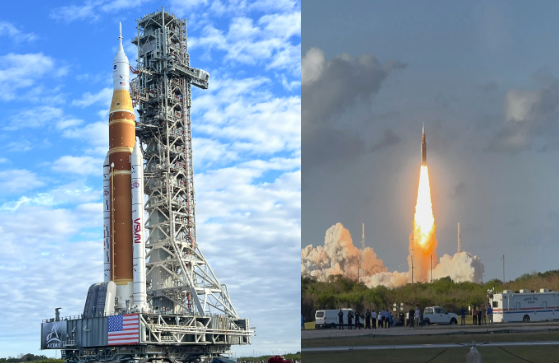
Caption 1: Mission to moom: A rocket soars into the atmosphere, leaving a trail of smoke and fire. The Artemis II mission, a monumental step in space exploration, launched from Kennedy Space Center in Florida on April 1, carrying a crew of four astronauts on a journey around the Moon. This launch signifies a crucial advancement in humanity's return to lunar exploration and future endeavors to Mars. When she saw the rocket and the images after, Carrie Friday said, “I thought that it was awesome, seeing them go up there and seeing the pictures showed how far humanity has gone.” Photo by Carrie Friday
Caption 2: BLAST OFF Standing tall on the launch pad, Artemis II prepares for liftoff as crowds gathered to witness the historic moment. “I believe that space exploration is important for human improvement. I really wanted to be an astronaut when I was younger, and when I saw the rocket it filled a little hole in younger me’s heart,” said Peyton Dodge, 9th grade. Photo by: Carrie Friday